
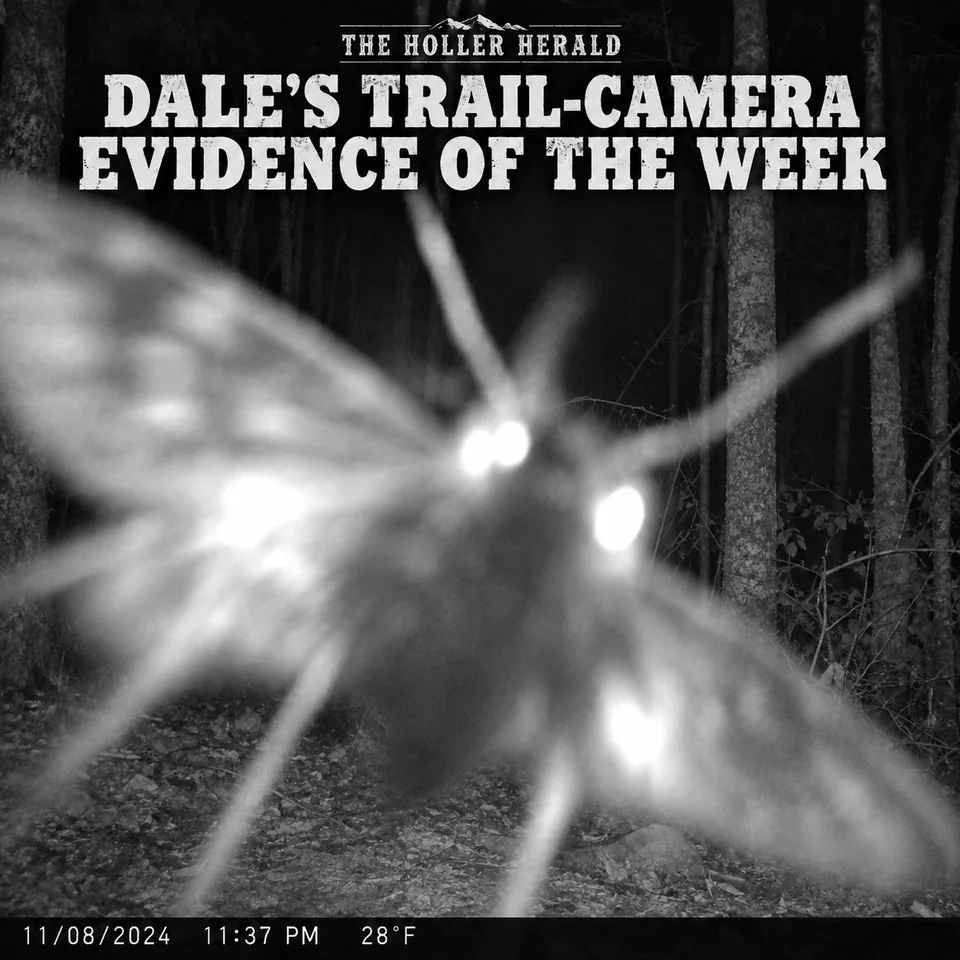
RANDOLPH COUNTY, WV — A blurry trail-camera photograph submitted to The Holler Herald has been identified by outdoors correspondent Dale Hatfield as definitive proof that an abnormally large elk is roaming the mountains of West Virginia.
The photograph, captured at 2:17 Monday morning, shows two glowing eyes, several indistinct legs and a shadowy mass that appears to occupy nearly the entire frame.
Dale studied the image for approximately eight seconds before reaching his conclusion.
“That’s an elk,” he said. “Big one, too. I’d put him somewhere between 550 and 720 pounds.”
The camera’s owner, Kevin Pritt, initially believed the photograph showed a raccoon, owl or possibly his thumb while adjusting the camera.
Dale dismissed all three explanations.
“You can tell it’s an elk by the way everything is blurry,” he explained. “Big animals create their own atmospheric distortion.”
Dale further determined that the animal was a mature bull traveling southeast at roughly 4 miles per hour, despite the photograph showing no visible antlers, identifiable direction or evidence that the creature was moving.
He also estimated the animal stood nearly nine feet tall.
Wildlife officials reviewed the image Tuesday afternoon and reached a different conclusion.
“It’s a moth,” biologist Andrea Chapman said. “It landed a few inches in front of the lens. The things Dale identified as legs are pine needles.”
Dale immediately rejected the agency’s findings.
“I’ve spent 40 years in the woods,” he said. “I know the difference between a moth and a 600-pound elk.”
When reporters enlarged the photograph, the creature appeared to have wings, antennae and the unmistakable body structure of a common brown moth.
Dale said this only strengthened his argument.
“That tells me we’re dealing with an elk that has adapted,” he explained.
Pritt later discovered three additional photographs taken seconds after the original image. The first clearly showed the moth crawling across the camera lens. The second showed it flying away.
The third showed a raccoon eating corn.
Dale identified the raccoon as a young black bear.
Officials said no further investigation was necessary.
Dale disagreed and plans to spend the remainder of the week searching the surrounding property for tracks, antler rubs and any unusually large holes in nearby sweaters.
At press time, he had estimated the moth’s wingspan at somewhere between four inches and six feet.
The Holler Herald — West Virginia’s Least Reliable News Source
If it happens in the hills, we’ll probably report it. If it didn’t, give us about twenty minutes.