
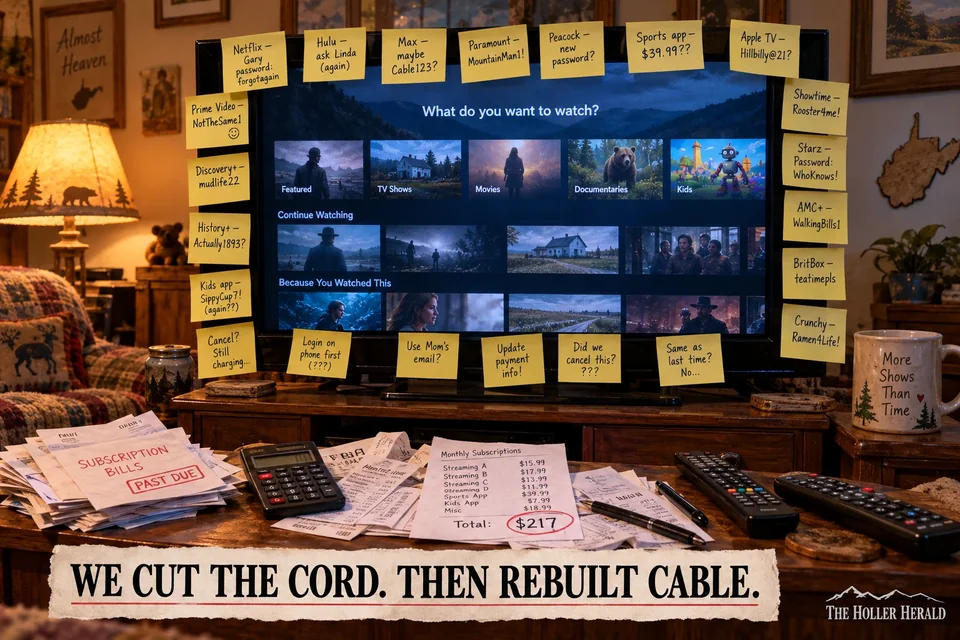
There was a time when Americans stood together against a common enemy: the cable company.
We were tired of paying $140 a month for 200 channels when we only watched six of them. We were tired of equipment rental fees, confusing packages and waiting between noon and Thursday for a technician to arrive.
Then streaming appeared.
For $8 a month, we could watch whatever we wanted, whenever we wanted. There were no contracts, no cable boxes and no channels devoted entirely to people purchasing abandoned storage units.
We had finally been set free.
Unfortunately, freedom now costs approximately $217 a month.
The average household currently subscribes to enough streaming services that watching television requires financial planning, password management and a working knowledge of corporate licensing agreements.
Want to watch one popular show? That requires Netflix.
Another show is on Hulu.
The movie everyone is discussing is on Max.
Your children want Disney+.
The football game is on Peacock, unless it is on Amazon Prime, ESPN+, Paramount+ or a completely new streaming service created sometime after lunch.
West Virginia resident Gary Thompson canceled cable five years ago after declaring that he would “never let those people rob him again.”
He currently subscribes to nine streaming services and maintains a handwritten list of passwords inside the television cabinet.
“I’m definitely saving money,” Thompson said while examining a credit-card statement. “At least I think I am. Does Amazon Prime count if we also use it to order paper towels?”
Thompson pays for Netflix, Hulu, Disney+, Max, Peacock, Paramount+, Amazon Prime, a sports package and a live television streaming service that carries the channels he lost when he canceled cable.
His total monthly cost is $83 more than his former cable bill.
“The whole reason I canceled cable was because I was paying for 200 channels I didn’t watch. Now I pay eight different companies to not watch the same amount of television.”
Streaming was supposed to make entertainment simpler. Instead, viewers must now determine which service owns each program, whether their subscription includes advertisements and why the show they started watching Tuesday disappeared by Friday.
Even canceling has become an investigation.
Signing up requires one click. Canceling requires navigating six menus, declining three special offers and locating a button printed in light gray text against a slightly different shade of gray.
Companies have also begun bundling streaming services together, allowing customers to pay one monthly price for several channels and programs in a single package.
Industry experts believe the next logical step will be providing customers with one bill, a central channel guide and a small box connected to the television.
A technician may even come to the house and install it.
Thompson said he would consider such a service.
“That sounds convenient,” he said. “As long as it isn’t cable.”