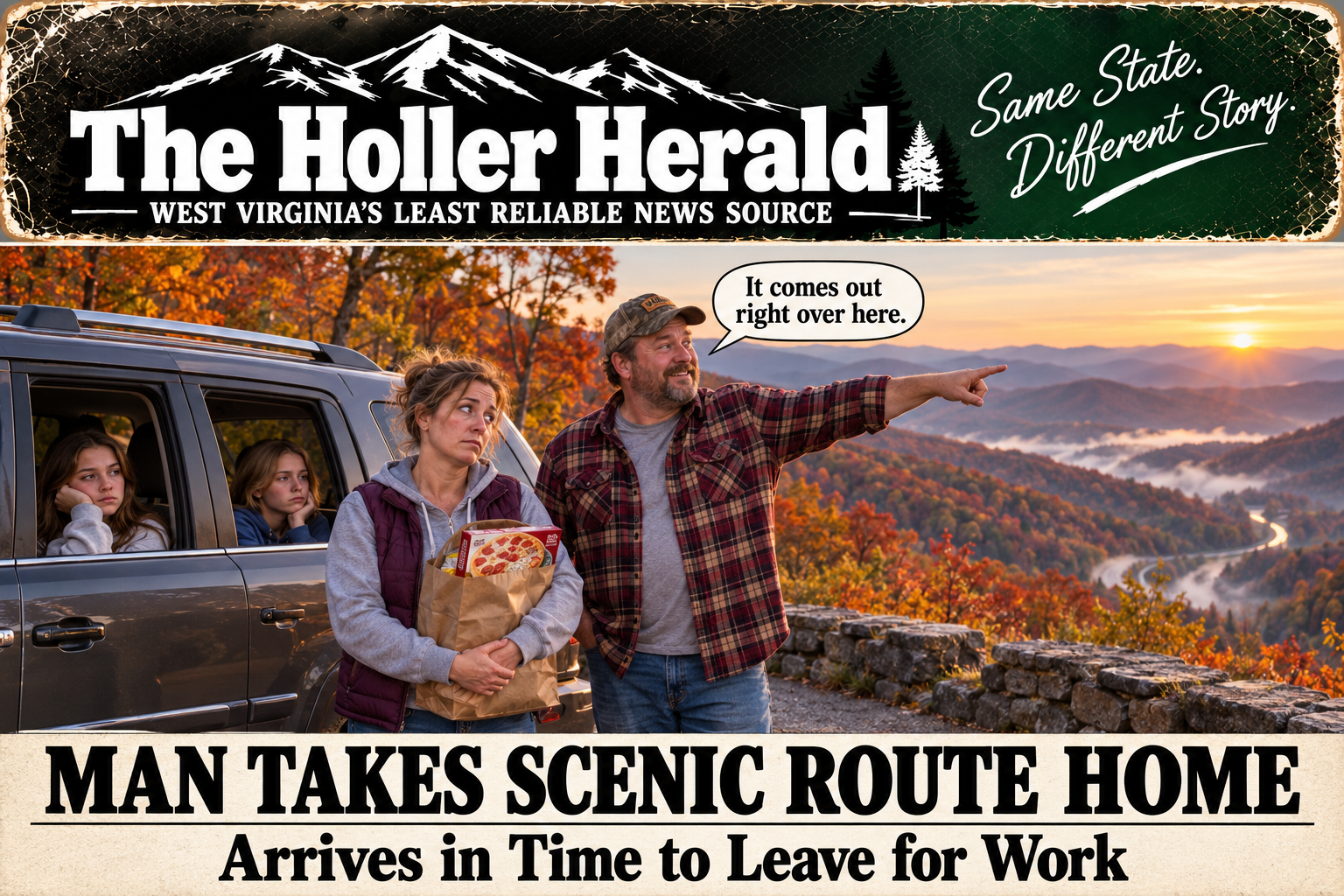
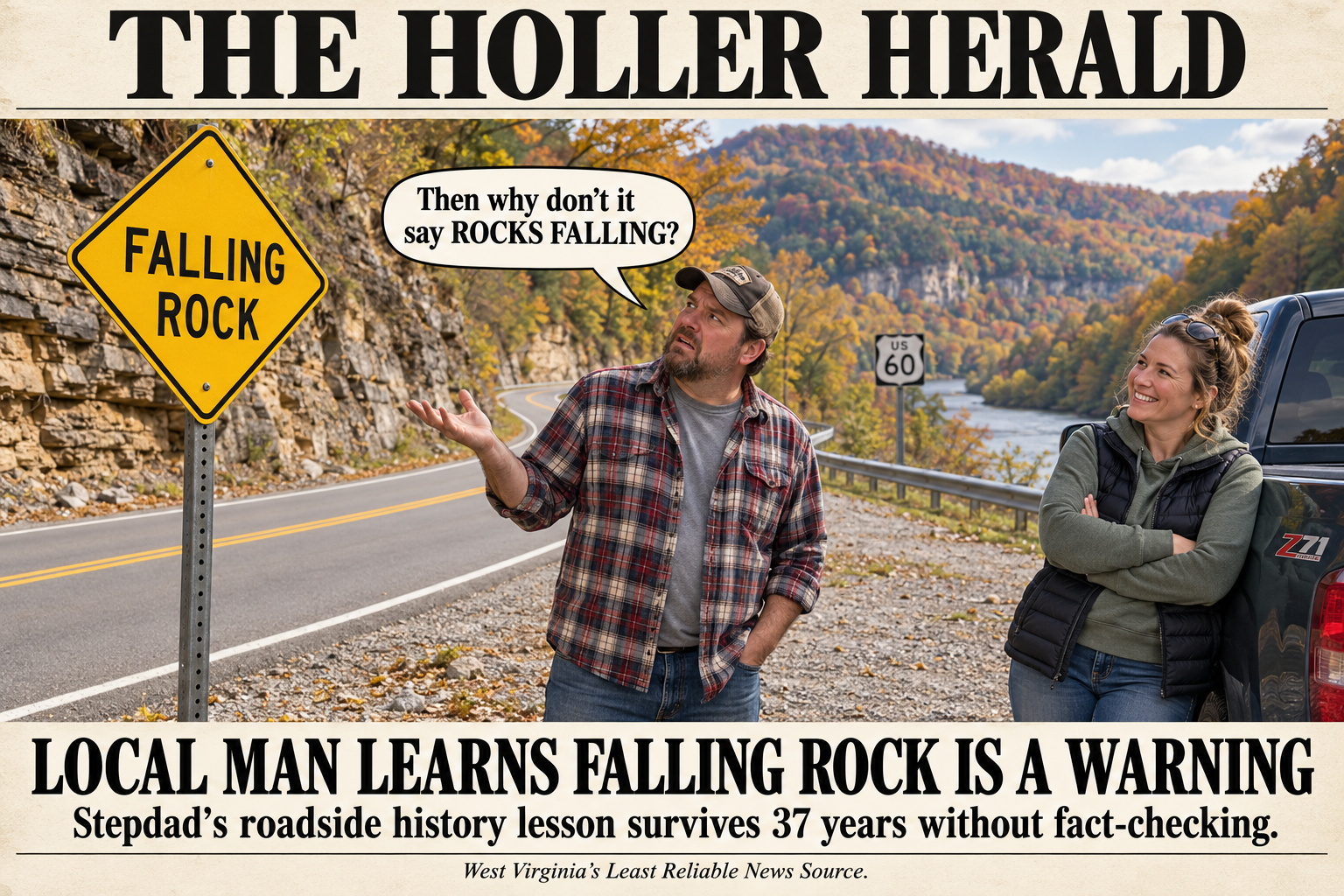
A West Virginia man’s understanding of regional history collapsed during a drive along Route 60 this week after his wife informed him that “Falling Rock” was a warning about the hillside and not the name of a missing girl his stepdad told him about in 1989.
Travis Blevins, 43, said he had spent more than three decades believing the roadside signs commemorated a Native American chief’s daughter who disappeared in the mountains.
According to the version delivered from behind the steering wheel of his stepdad’s pickup, the chief had ordered signs placed throughout the region so Falling Rock would never be forgotten.
“He knew her name, where she disappeared, and why the state got involved,” Blevins said. “I was six. I didn’t think to question his sources.”
The story remained a settled part of Blevins’ education until Saturday, when his wife, Melissa, pointed toward a rocky slope outside Gauley Bridge and remarked that she wouldn’t want to be underneath it during a hard rain.
Blevins responded that the sign had nothing to do with the rocks.
The conversation that followed caused him to miss his turn.
“He explained the whole thing to me,” Melissa said. “Very respectfully. Like I was the one who didn’t know the history.”
Blevins said his stepdad, Ronnie, had anticipated several questions during the original telling.
When young Travis asked why there were so many signs, Ronnie explained that they had searched a pretty big area.
When he asked why the signs were always near cliffs, Ronnie said that was where they had last seen her.
When he asked whether they ever found her, Ronnie looked through the windshield for a moment before quietly replying, “Not yet.”
“That ‘not yet’ stayed with me,” Blevins said. “Every time we went through there, I’d look.”
By middle school, Blevins had begun privately questioning the effectiveness of the search.
“I figured somebody ought to put her picture on one,” he said. “You’ve got signs in four counties and not one description.”
He never raised the issue with authorities, assuming there were details the family preferred to keep private.
Melissa said the revelation was made more difficult by her husband’s insistence that a warning about falling rocks would have been worded differently.
“He kept saying, ‘Then why doesn’t it say ROCKS FALLING?’” she said. “Like he was about to get this overturned on a technicality.”
Seeking an independent opinion, Blevins approached a highway worker at a gas station and asked what the signs meant.
The worker confirmed that they warned motorists about loose rock that could fall into the road.
Blevins asked whether that explanation applied to all of them.
“He wanted to know if there were maybe two programs using the same sign,” the worker said.
The employee declined to comment on the word order.
“I patch pavement,” he said. “They don’t let me write.”
Blevins then called his older sister, Carla, who confirmed that she had also believed the story well into adulthood.
She had learned the truth several years earlier but assumed Travis already knew.
“You hate to call your brother out of the blue and ask if he understands rocks,” she said.
Carla added that she had always suspected Ronnie embellished parts of the account, particularly the later introduction of Falling Rock’s boyfriend, Slippery When Wet.
“That felt like he was adding characters because we’d gotten stuck behind a coal truck,” she said.
Reached by telephone, Ronnie initially denied remembering the story.
After Travis repeated several details, including the chief’s search, the roadside memorials, and the solemn promise that the girl would never be forgotten, Ronnie was quiet for approximately eight seconds.
“Well,” he finally said, “I reckon they found her.”
Blevins said he could hear his mother laughing in the background.
Ronnie declined to apologize, explaining that the trip had been long and the children had already asked where they were going seventeen times.
“You wanted a story,” he said. “I gave you one with local landmarks.”
The discovery has prompted Blevins to reconsider several other things Ronnie told him during childhood car rides.
Among them are claims that cows lie down because their legs get tired of standing uphill, the truck’s interior light could get the whole family arrested, and a restaurant described as “too expensive” was permanently closed.
Melissa said her husband has taken the news reasonably well, although he remains troubled by the number of adults who allowed the story to continue.
“My mom was in the truck,” Blevins said. “She had every opportunity.”
At press time, Blevins was still slowing down whenever he passed a Falling Rock sign.
“Out of respect,” he said.
The Holler Herald — West Virginia’s Least Reliable News Source.