West Virginians disagree about plenty of things.
We disagree about politics, football, the proper pronunciation of certain town names and exactly where southern West Virginia ends and northern West Virginia begins.
Some residents put slaw on their hot dogs. Others do not. Certain people add ketchup, although they generally avoid admitting it in public.
These disagreements are understandable. Most can be discussed calmly among reasonable adults.
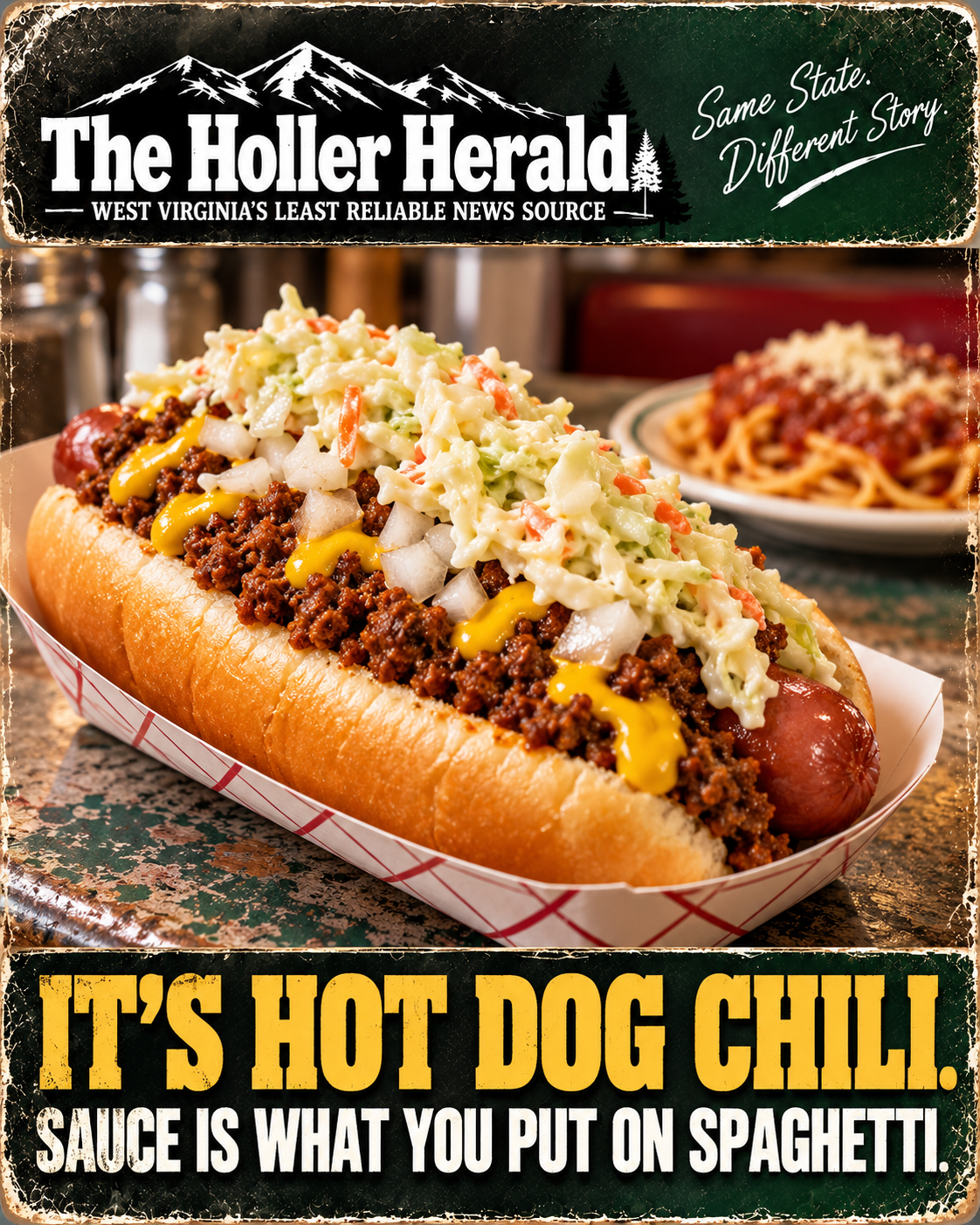
But the meat mixture placed on top of a West Virginia hot dog is called chili.
It is not sauce.
Sauce is what you put on spaghetti. Sauce comes in a jar. Sauce is something a waiter drizzles artistically across a plate before charging you $26 for six ravioli.
Hot dog chili comes from a dented pot that has been sitting on the stove since 9 o’clock that morning. It was prepared using a recipe somebody’s grandmother refuses to write down because she measures every ingredient “until it looks right.”
There is a difference.
Supporters of the word “sauce” argue that the mixture is technically a meat sauce because it is thinner than a bowl of traditional chili and generally contains no beans.
This is the sort of argument people make when they have realized they are wrong but own a dictionary.
West Virginia hot dog chili does not need beans. It does not need chunks of tomato, shredded cheese or a national chili organization’s permission to exist.
It needs ground beef, seasoning and enough liquid to soak through the bun before you reach the car.
That is the standard.
The Holler Herald recently conducted an extensive culinary investigation by asking seven people standing outside a convenience store what they called it.
Five said chili.
One said sauce.
The seventh asked if we were going to buy him a hot dog or just keep bothering him.
Although the results have not been peer-reviewed, we consider the matter settled.
“Sauce people always want to turn this into a technical discussion,” said local hot dog historian Linda Kay Parsons, whose qualifications include eating three hot dogs at the county fair last summer. “Nobody has ever leaned through the window at a dairy bar and ordered two with mustard, onions and meat sauce without everybody inside immediately becoming suspicious.”
Parsons said regional traditions should be respected but acknowledged that some terminology is simply too dangerous to tolerate.
“If somebody calls it sauce, I’m not saying they’re a bad person,” she explained. “I’m just saying I wouldn’t let them make the hot dogs.”
The debate becomes even more complicated when slaw is introduced.
In much of West Virginia, the proper hot dog includes chili, mustard, onions and coleslaw. In other areas, slaw is considered optional or completely unnecessary.
We are not prepared to resolve that disagreement today.
The Holler Herald has limited legal resources, and several members of the editorial board have family living on opposite sides of the slaw line.
We will therefore focus on the one principle capable of bringing most of the state together:
Whatever else you put on the hot dog, the meat is chili.
Calling it sauce does not make it more accurate. It only makes the person taking your order pause long enough to reconsider every decision that led them to that moment.
Imagine applying this kind of reckless renaming to other West Virginia foods.
Would we call a pepperoni roll “meat-stuffed bread”?
Would we describe soup beans as “legume stew”?
Would we advertise ramps as “aggressively scented mountain onions”?
Technically, perhaps.
But technical accuracy is not the same as being welcome at the family reunion.
Language matters. Traditions matter. The words we use tell people where we come from, how we were raised and whether they should trust us with an important food order.
When a West Virginian says “hot dog chili,” everyone understands what is being discussed. They picture the finely ground meat, the seasoned aroma and the paper wrapper already beginning to turn transparent.
When someone says “hot dog sauce,” it sounds like a condiment produced in a factory and sold beside the barbecue sauce.
That is not our heritage.
Our heritage is a pot with no written recipe, a wooden spoon permanently stained orange and an aunt who insists the secret ingredient cannot be revealed until somebody dies.
This editorial is not intended to divide West Virginia.
It is intended to unite the state by declaring one side completely wrong.
You may add slaw. You may reject slaw. You may use mustard, onions or enough hot pepper to remove the lining from your mouth.
You may even add ketchup, although we encourage you to consider why you feel the need to do that.
But the meat on top is chili.
This is not merely our opinion.
It is our opinion that we have decided is a fact.
The Holler Herald — West Virginia’s Least Reliable News Source
If it happens in the hills, we’ll probably report it. If it didn’t, give us about twenty minutes.