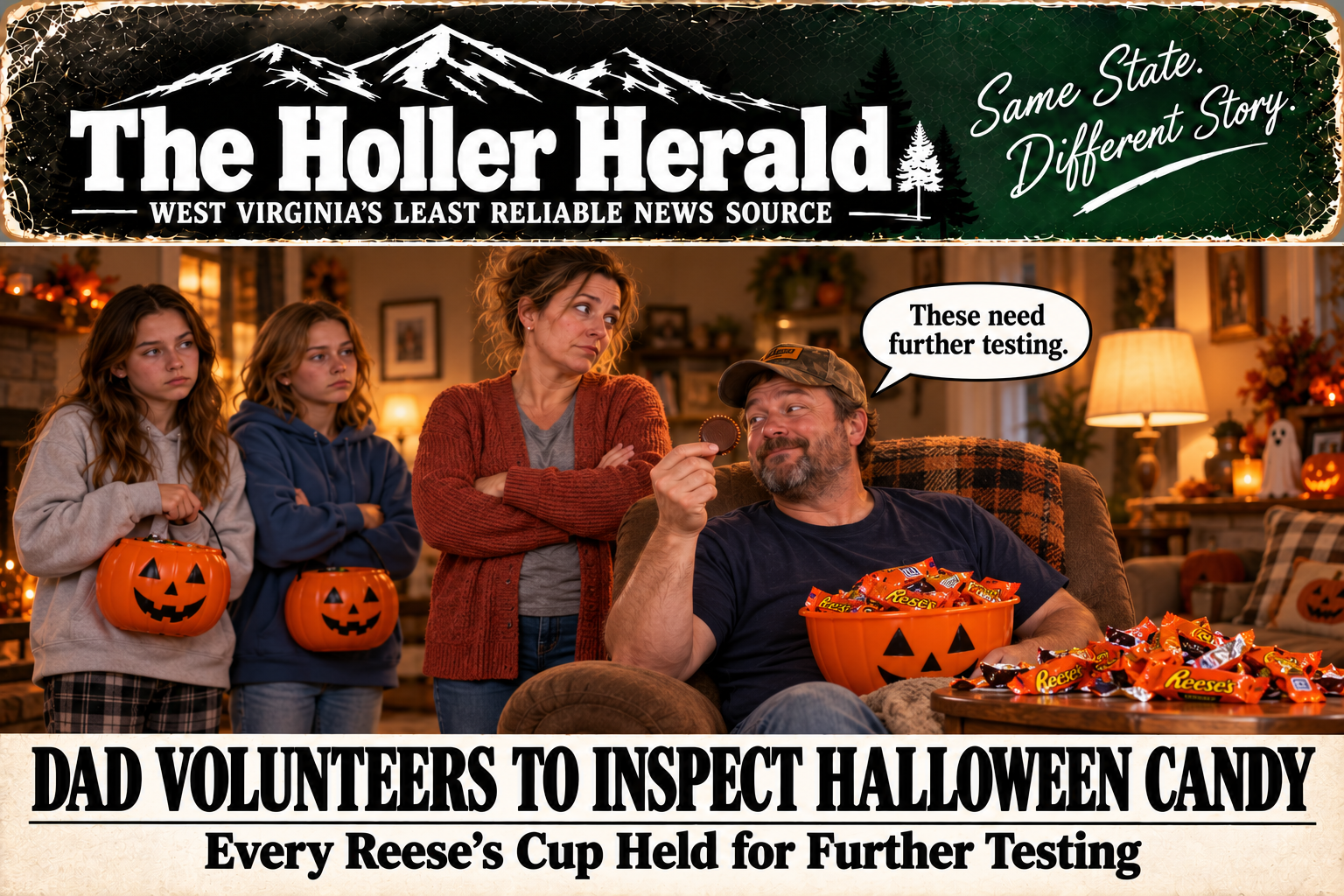
A West Virginia father has assumed responsibility for inspecting his children’s Halloween candy, immediately placing all peanut butter cups under a precautionary hold that family members believe could remain in effect until they are gone.
Kevin Hensley, 45, announced the procedure Friday while reviewing plans for the family’s trick-or-treat outing.
“Before anybody eats anything, it comes through me,” he said. “That’s just being a parent.”
His wife, Melissa, asked whether this was the same parenting standard that allowed him to consume two bags of the household’s giveaway candy earlier in the week.
Hensley said that had been a separate investigation.
“That was supply-side.”
Under the new system, candy collected by either daughter will be emptied onto the kitchen table, sorted by type, and examined for anything Hensley considers unusual.
He has already identified Reese’s cups, Snickers, and “possibly some of them little Kit Kats” as items requiring closer attention.
His oldest daughter asked what specifically was wrong with them.
“That’s what we’re trying to find out.”
Hensley said the inspection would begin with a visual assessment of each wrapper, followed by additional testing where necessary.
Asked what would make additional testing necessary, he said he would know when he saw it.
Melissa noted that his list closely resembled the candy he requests at gas stations.
“Criminals know what people like,” he replied.
The proposed testing facility consists of a recliner, a television remote, and a small bowl normally used for pretzels.
Hensley has requested that the bowl be brought to him.
“For chain of custody.”
His younger daughter said she would prefer to keep custody of her own candy.
Hensley explained that this was exactly the sort of emotional response that could compromise an investigation.
“I need everybody to let me do my job.”
The family’s concerns intensified after Hensley outlined a process in which a suspicious candy bar would be opened, examined, and tasted.
Any remaining portion would then be retained as evidence.
“What remaining portion?” Melissa asked.
Hensley said that would depend on the size of the sample.
Fun-size bars, he acknowledged, presented particular challenges.
“You don’t get much room to work.”
According to Hensley, one successful test would not automatically clear other candies of the same type.
He described each individually wrapped piece as “its own situation.”
His oldest daughter asked whether he could inspect an Almond Joy first.
Hensley looked at the package and cleared it immediately.
“That one’s fine.”
A box of raisins received similar approval without being opened.
Asked how those items could be declared safe from across the room while peanut butter cups required extended testing, Hensley said experience matters.
“You do this long enough, you develop an eye.”
Melissa has proposed an alternative system in which she checks the candy and Kevin receives a small, agreed-upon share afterward.
Hensley said he was uncomfortable allowing a quota to influence his findings.
“I can’t promise the evidence will cooperate with whatever number you’ve got in your head.”
He also objected to referring to his work as a “dad tax.”
“This is a public service.”
Both daughters have begun discussing ways to protect their collections, including maintaining separate inventories and placing lower-priority candy on top.
Hensley said concealing evidence would only make the inspection take longer.
Melissa informed him that he was talking about two children’s pumpkin buckets as though they were the subject of a federal search warrant.
“I’m trying to keep this informal,” he said.
The Holler Herald Editorial Board reviewed the proposed procedure and found no apparent reason that Hensley’s favorite candies would consistently require the most destructive testing.
Hensley called the finding premature and invited the board to return after he had collected more data.
He declined to provide the existing samples.
At press time, Hensley had cleared every Reese’s cup wrapper in the house.
The contents remain unaccounted for.
The Holler Herald — West Virginia’s Least Reliable News Source.