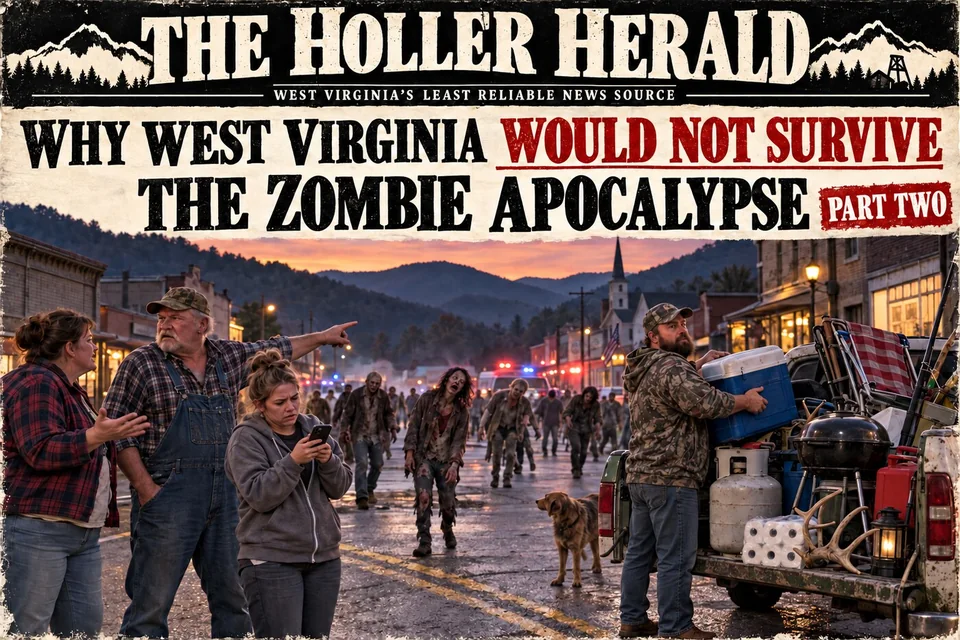
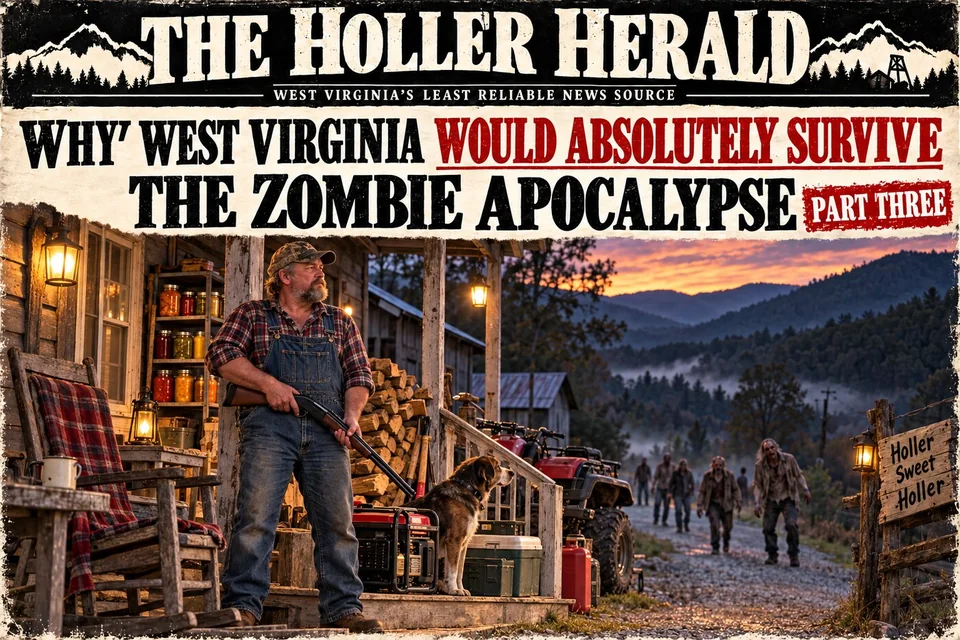
CHARLESTON, WV — After previously examining the many reasons West Virginia might not survive a zombie apocalypse, The Holler Herald’s emergency preparedness team has reached a different—and considerably louder—conclusion.
West Virginia would be fine.
The zombies, however, would be in serious trouble.
According to a statistic that could not be independently verified because everyone stopped counting, West Virginia possesses approximately five firearms for every resident, plus several more in closets, truck consoles and gun safes whose combinations have been forgotten.
Within minutes of the first emergency alert, every sporting-goods store would be empty. Not because residents needed additional weapons, but because nobody has ever considered “enough ammunition” to be a real number.
The state’s geography would provide another significant advantage.
Zombies accustomed to flat city streets would quickly encounter mountains, washed-out roads and driveways requiring four-wheel drive even during perfect weather.
Entire communities would remain undiscovered because navigation apps routinely announce “You have arrived” while the destination is still six miles away on the opposite side of a ridge.
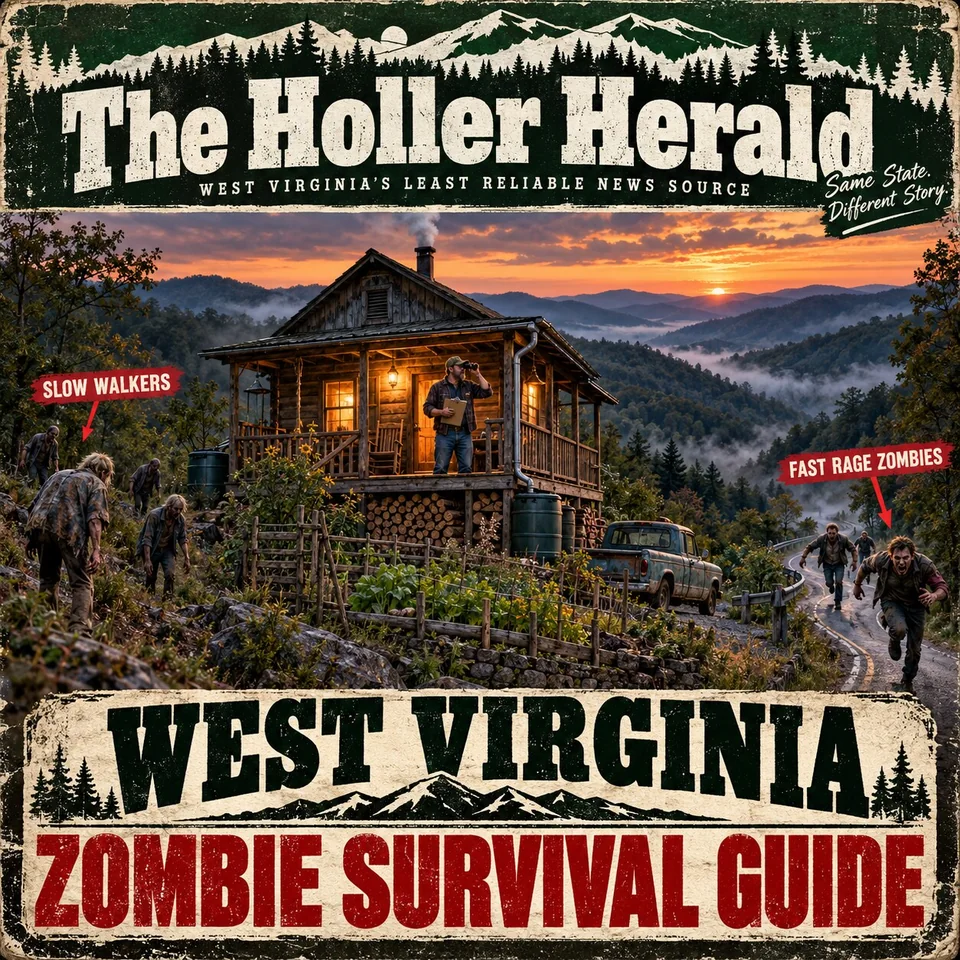
Even fast zombies would struggle after climbing their third hill.
Slow zombies would not reach anyone until spring.
West Virginians also possess generations of practical knowledge largely ignored during normal civilization but suddenly invaluable after its collapse.
Residents can preserve food, grow gardens, repair machinery, identify animal tracks and start a fire using three damp sticks, dryer lint and an old receipt from Tractor Supply.
Nearly every family knows at least one person capable of turning a lawnmower engine, scrap lumber and several questionable welds into a functional escape vehicle.
It would not be safe.
It would, however, run.
Food supplies would present little concern.
Freezers across the state already contain enough venison to survive several winters, although nobody can identify the freezer-burned package at the bottom marked only “MEAT — 2019.”
Additional provisions could be found in basements filled with canned green beans, pickles, apple butter and jars whose contents should probably not be opened indoors.
Those attempting to raid rural homes would discover that West Virginians do not consider being without electricity an emergency until at least the third day.
Generators would appear from garages. Wood stoves would heat entire houses. Water would be collected from springs that residents insist are perfectly safe because their grandfather drank from them and lived to 94.
Communication would continue without phones or internet.
News of the outbreak would travel through volunteer fire departments, church parking lots and one woman named Brenda who somehow knows what happened before it happens.
By sundown, Brenda would have identified the location of every zombie, the names of their living relatives and which one still owes her $40.
The greatest West Virginia advantage, however, would be stubbornness.
Zombies rely on fear and panic. West Virginians regularly argue with bears, floodwater, power companies and malfunctioning riding mowers.
The undead would surround one resident’s home and demand entry.
“No,” the resident would reply.
The standoff would continue indefinitely.
Survivors would eventually establish fortified settlements in hollows, hunting camps and abandoned schools. Four-wheelers would patrol the ridgelines while retired coal miners constructed defenses strong enough to withstand both the undead and a federal inspection.
The zombies might overrun the cities.
They might control the highways.
But the moment they turned onto an unmarked gravel road and passed a hand-painted sign reading TRESPASSERS WILL BE SHOT, their advance would come to an abrupt and educational conclusion.
West Virginia may have plenty of problems.
A shortage of hills, canned food, firearms and people willing to defend their property has never been among them.
The Holler Herald — West Virginia’s Least Reliable News Source
If it happens in the hills, we’ll probably report it. If it didn’t, give us about twenty minutes.